
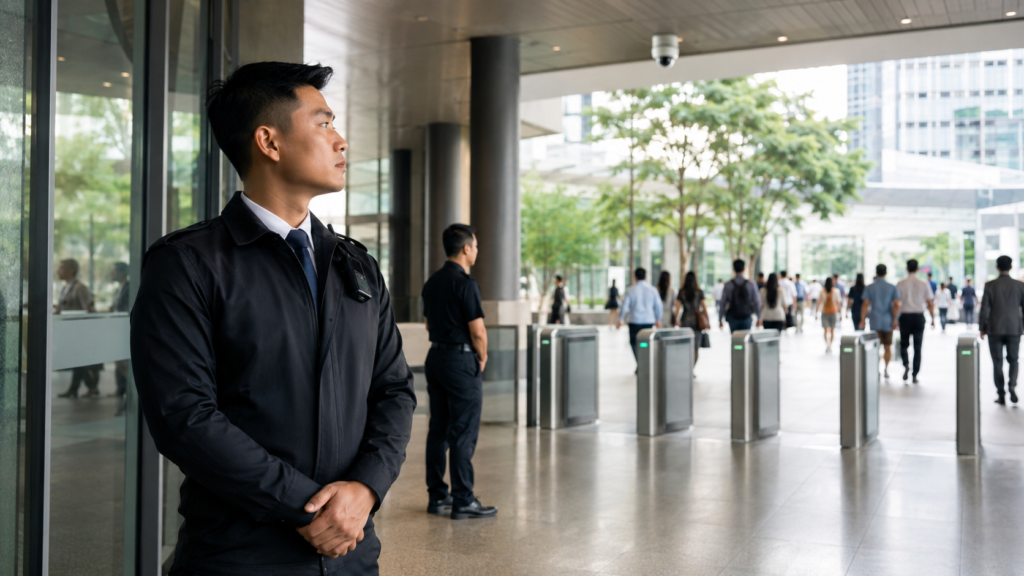
In high-footfall environments, the volume of people moving through a space on any given day makes consistent threat detection genuinely difficult. While security officers, building managers and frontline staff are not expected to be counterterrorism experts, they are expected to know enough to notice when something is wrong and to respond in a way that gives the right people the information they need, quickly. Building that capability across an organisation is what a structured approach to terrorist threat detection looks like.
Terrorist attacks targeting public spaces, commercial buildings and transport hubs are rarely entirely spontaneous. Most involve planning, reconnaissance and preparation, and that process leaves observable traces. Security personnel who understand this are better equipped to connect individual observations into a meaningful picture.
A person photographing entry points, someone asking unusually specific questions about building access or a vehicle conducting repeated slow passes near a venue are all individually explainable. Together, however, they may indicate something that warrants closer attention. The threat environment in Singapore is shaped by both regional and global factors, and ground-level detection by trained security personnel remains a critical layer of the overall system.
Behavioural detection is one of the most practical tools available to security officers. Unlike weapons or devices, which may be concealed, behaviour is observable. Common indicators that warrant attention include:
No single indicator is conclusive. The skill lies in contextual judgement—assessing whether a combination of behaviours, in a specific environment, crosses the threshold for escalation.
Officers need a clear, practised framework for assessing unattended items and suspicious vehicles. For unattended items, the key questions are:
If any of these cannot be answered satisfactorily, treat the item as suspicious and activate the appropriate protocol. For vehicles, indicators include parking in prohibited locations near high-value targets, repeated passes through the same area and drivers who behave evasively when approached.
Detection without action has no security value. One of the most common failure points in threat detection is not a lack of awareness but a reluctance to escalate. Officers hesitate because they are uncertain or fear overreacting.
Sustained vigilance is harder than it sounds. Attention dips during quiet periods, and in environments where nothing unusual has happened for weeks, the instinct to relax is understandable. Practical strategies for maintaining consistent vigilance include:
Sometimes, the people who notice something unusual are not the officer on patrol but the receptionist, the facilities technician or the retail staff member who works the same floor every day. Building a detection-aware culture means:
Technology can monitor, record and alert. What it cannot do is exercise contextual judgement, read a room or decide in real time whether a situation warrants immediate escalation. That remains the work of trained people, and the quality of that training is one of the most consequential investments a security operation can make.
KnowledgeTree’s Recognise Terrorist Threats (RTT) course is a WSQ-accredited, SSG-approved programme that equips security officers with the knowledge and practical frameworks to identify, assess and escalate potential terrorist threats. It is one of the three Basic Licensing Units required for a security officer licence in Singapore, and a foundational component of professional security practice. Register now at www.ktree.com.sg and build the detection skills that the role demands.